As an Amazon Associate, I earn from qualifying purchases. That means I earn commissions from my sponsored links or I make money when readers (you) purchase items through my links. Your purchase allows me to continue working as a stay-at-home dad who moonlights as a farmer and a musician. Needless to say, this post contains affiliate links.
I’ve been living in Davao for a good third of my life now. And every August when Kadayawan comes around, I feel something I don’t feel anywhere else.
I feel like I’m exactly where I’m supposed to be.
That wasn’t always true about any place for me.
I’m from Tacloban City, Leyte originally — born there, spent most of my early years there, school, childhood, lifelong friends, got involved with music and art there.
But I also spent summers in Siocon, in Cebu, in Manila.
I lived in Manila for years, long enough to build a career there, long enough to call it home before I upped and left.
Siocon is where I learned what it means to be a farm boy, which turns out to be a valuable lifelong skill set that you can use in or out of a city.
Manila is where my career started in earnest, managing call centers, learning what it means to work hard in a pace that doesn’t slow down for anyone.
But in 2011 I landed in Davao City and something happened that hadn’t happened in any of the other places.
I stopped wanting to go anywhere else.
This is where I found myself.
Found peace and also excitement, which is a combination most places can only offer one of at a time.
Found the value of family.
I found a place where I could put my roots down, met the woman I ended up marrying.
I now have an amazing kid with her.
Davao is also where I met friends who feel like they’ve always been in my life.
Davao is my forever home.
Not a halfway way station.
Not a chapter.
Home.
And Kadayawan is the moment every year when this city reminds me exactly why I feel that way.
What is Kadayawan?
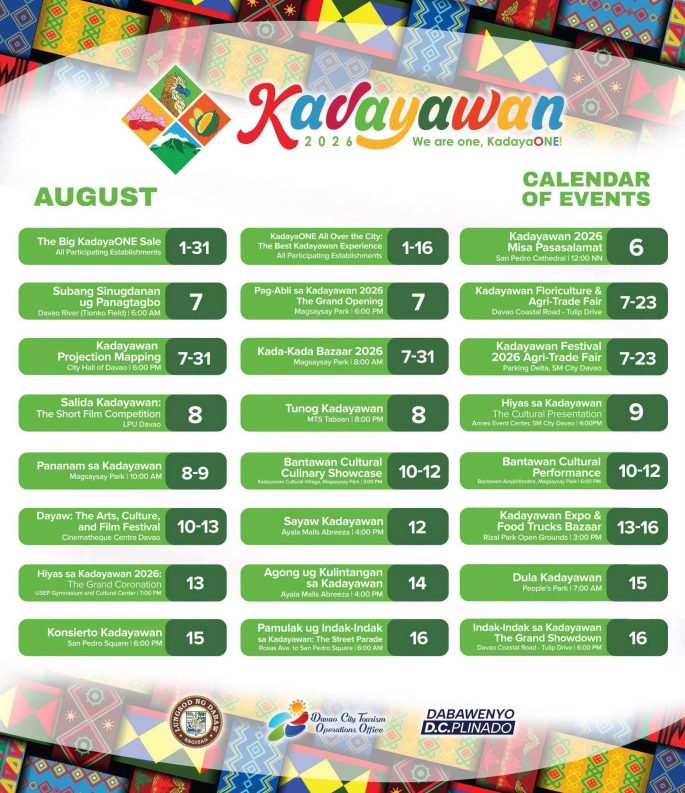
The name comes from the Mandaya word madayaw.
You’ve probably heard it used as a greeting if you’ve been to any official Davao event — the way people here say hello and goodbye and sometimes just express that something is good.
The word is hard to translate fully into English because something that is madayaw is valuable and good and beautiful all at once.
That’s a good name for a festival.
Unlike most Filipino festivals which are tied to a religious patron saint, Kadayawan is fundamentally a harvest celebration.
A thanksgiving.
August in Davao coincides with the peak of the fruit harvest season — durian, mangosteen, rambutan, pomelo, marang — and the festival is the city’s way of saying thank you to the land that produces all of it.
You can feel that gratitude in the air during August in Davao in a way that is genuinely different from any other time of year.
But Kadayawan is also something bigger than a harvest festival.
It is a tribute to the 11 recognized indigenous and Moro tribes whose presence on this land predates the city by centuries.
Lumad Tribes
- Atta
- Bagobo-Klata
- Bagobo-Tagabawa
- Matigsalug
- Ovu-Manuvo
Moro Tribes
- Iraunun
- Kagan
- Maranao
- Maguindanaon
- Sama
- Tausug
These tribes participate actively during Kadayawan, displaying — ancestral traditions, traditional attire, music, dances, and ancient rituals.
The Kadayawan Village in People’s Park sets up full-scale traditional houses for each of the 11 tribes where visitors can experience their architecture, cuisine, crafts, and ways of life up close.
That gives you a better understanding of Davao and Kadayawan is the annual reminder of just how layered and diverse this city’s identity actually is.
Events
Kadayawan is a celebration spread over the entire month.
And across that month the city fills up with events that collectively make August the most exciting month on the Davao calendar by a significant margin.
Indak-Indak sa Kadayawan
Indak-indak sa Kadayawan is a street dancing competition where performers in elaborate tribal-inspired costumes move through the main streets to the beat of indigenous instruments and gongs.
This is the one that fills the roads with color and sound and makes you understand viscerally what the festival is celebrating.
Standing on a street corner watching Indak-Indak is one of those Davao experiences you remember for years.
Pamulak sa Kadayawan
The grand floral float parade.
Massive floats built entirely from fresh flowers, fruits, and indigenous natural materials moving through the city. The Waling-Waling orchid — the Queen of Philippine Orchids — features prominently because this is also its natural home.
Why do I know that? My aunt who is my mom’s sister, is aptly named Waling-waling because of her beauty. Really. My mom’s name is Rose, her other sister was named Dahlia. They all had flower-inspired names. Except for my other aunt whose name is Celita.
I don’t know why…
Anyhoo…
The craftsmanship on display is extraordinary and the smell of all those fresh flowers in the August air is something no photographer has ever fully captured.
Subang Sinugdanan & Panagtagbo
Reenactments and gatherings along the riverfront celebrating the historical meeting and peaceful co-existence of the tribes.
The river has always been central to the history of this city and Panagtagbo is the festival’s way of honoring that history without reducing it to a performance.
Kadayawan Village · People’s Park
The living exhibit of all 11 tribes. Full-scale traditional houses, food, crafts, daily life on display. If you only go to one Kadayawan event this year make it this one — especially if you have kids. It changes how you see the city you’re living in.
What Kadayawan Means for Music and Local Artists
August Is the Best Month to Be a Musician in Davao
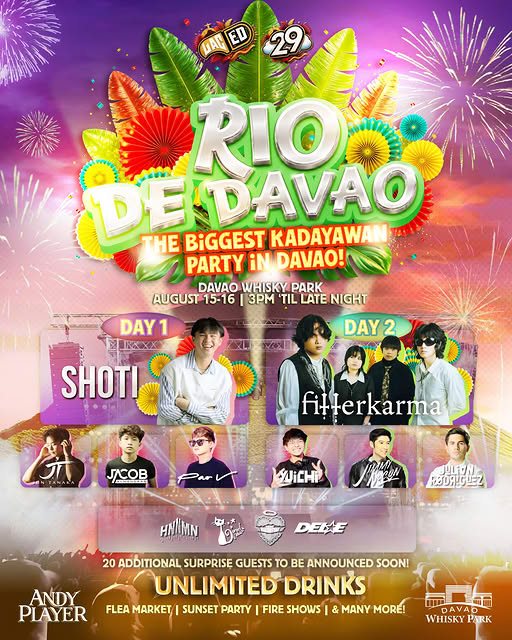
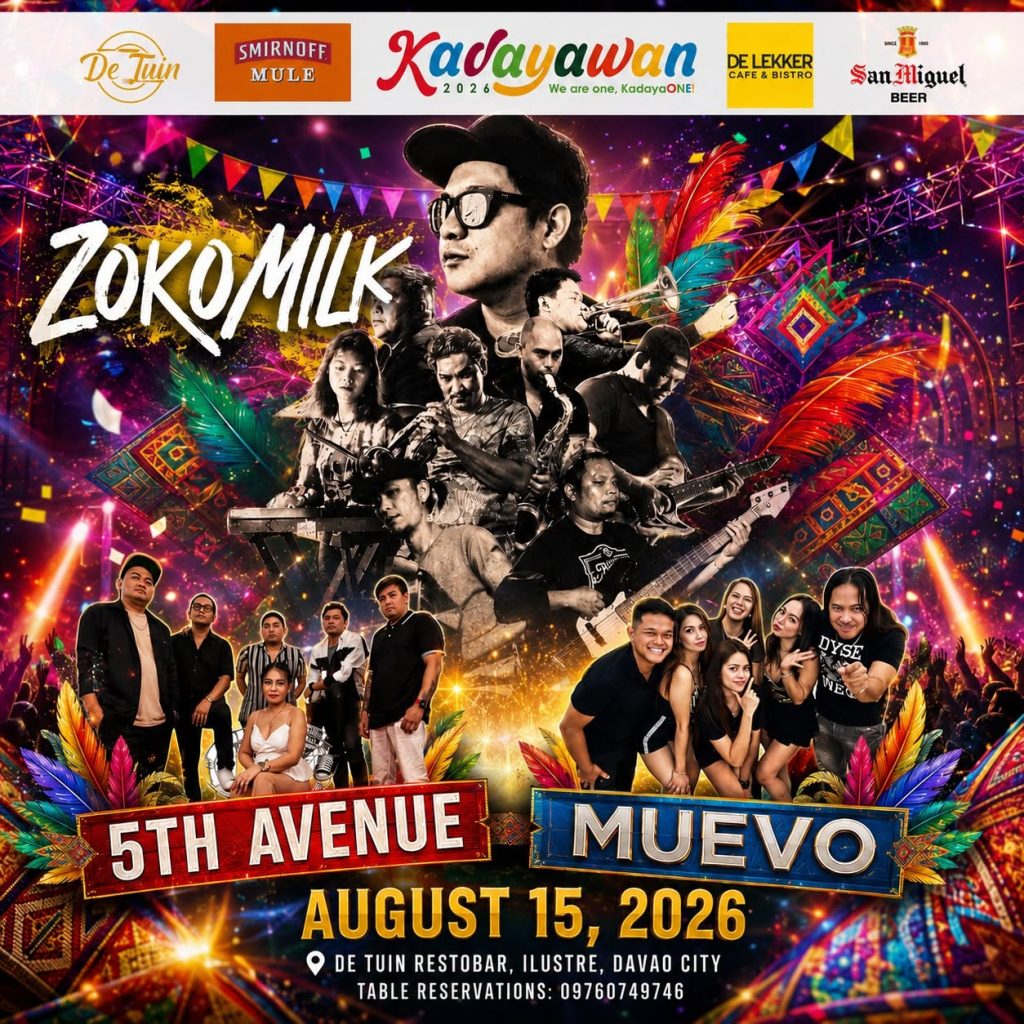
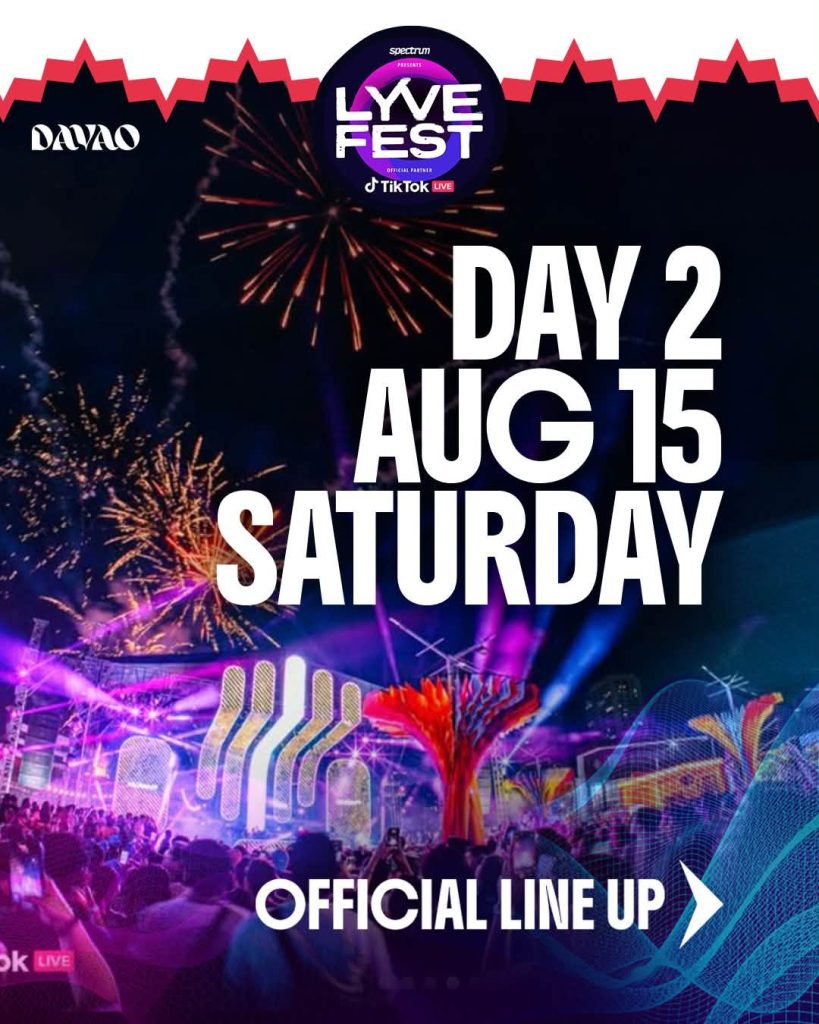
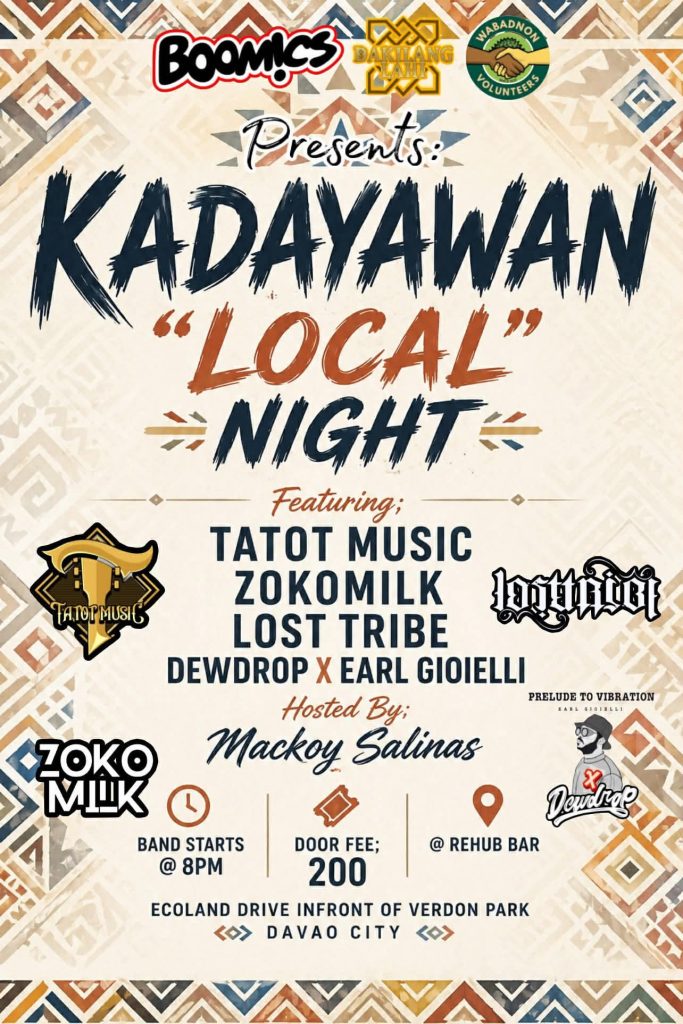
Kadayawan brings an explosion of live music opportunities across the metro.
Stages go up in places that don’t normally have stages. Events need bands.
Bars and venues capitalize on the increased foot traffic and weekend energy by booking more aggressively. Local artists who’ve been building their following all year get a concentrated window of visibility that doesn’t exist in quite the same way any other month.
For original acts especially — Tamad si Juan, Project Satellite, Quarterlife Crisis, and TrashBunk to name a few, Kadayawan is the month where playing in Davao feels bigger than a regular gig.
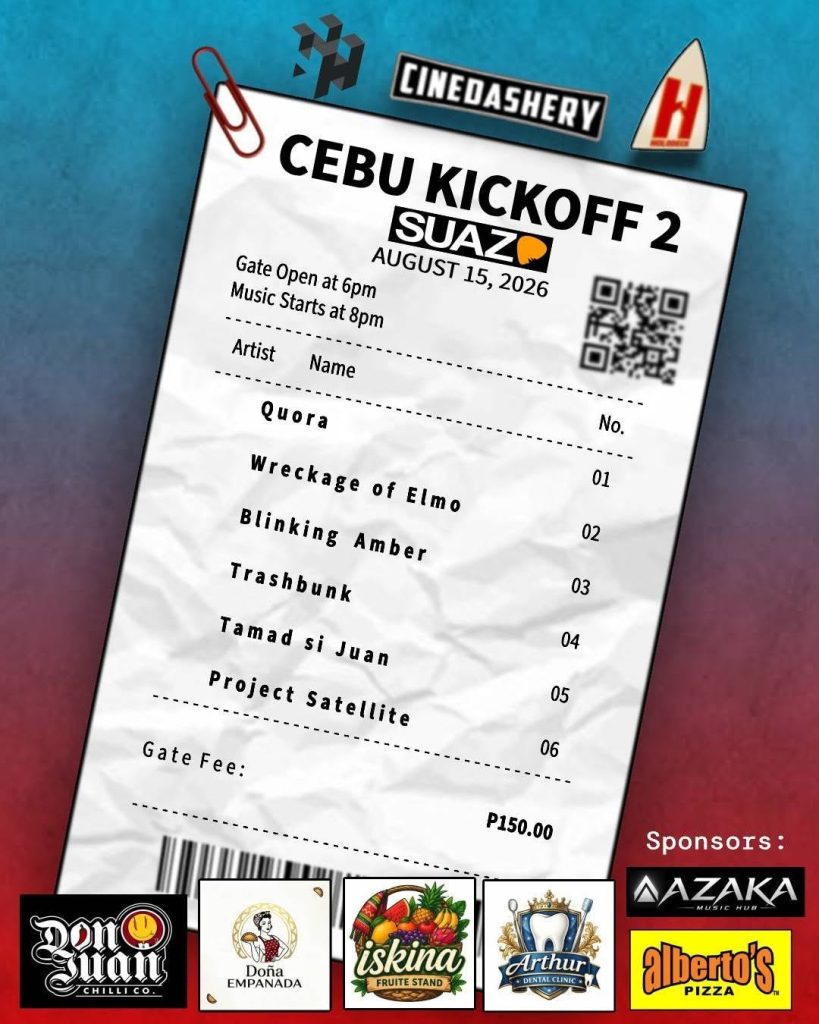
The city is awake in August.
The audience is bigger, more diverse, more open to discovery because there’s already a festival energy in the air that makes people willing to try something new.
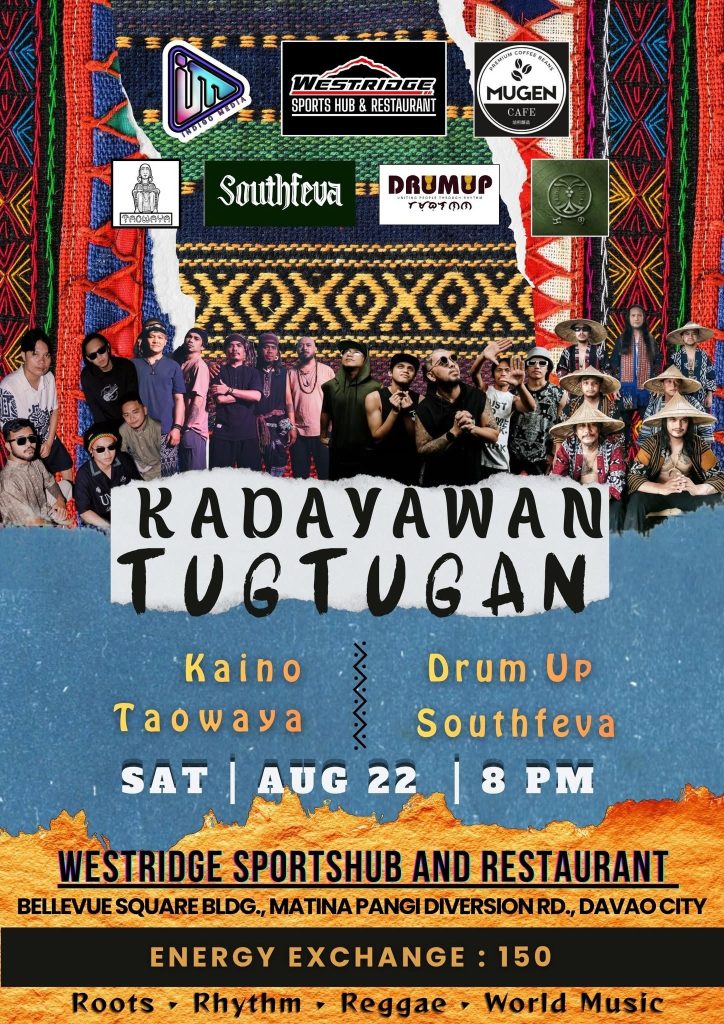


Local businesses feel it too.
The tourism that Kadayawan brings to Davao lifts everything — restaurants, bars, venues, merch stalls, the food trucks outside gig venues.
A scene that supports itself financially is a scene that can keep making music and Kadayawan gives the whole ecosystem a boost at the mid-point of the year when it needs it most.
I’ve been to a lot of Kadayawans now.
And every single year, I am genuinely proud to be living in this city despite not being a natural-born Davaoeno.
There’s pride there.
Every August everyone is reminded of where they came from, honoring the people who were here before, and to celebrate the land that feeds everyone.
I came to Davao on a whim, someone who arrived without a plan and chose to stay.
But Kadayawan every year is the city’s reminder that this place has been remarkable long before any of us settlers showed up.
That’s a very humbling thought.
Come for August. Stay for the Rest of Your Life.
If you’ve never experienced Kadayawan in Davao, August is the time to come.
Not just for the parades and the street dancing, though those are worth the trip alone. Come for what the festival represents — a city that knows how to celebrate its complexity, honor its indigenous heritage, give thanks for its abundance, and fill the streets with music while doing all of it.
If you’re already in Davao, you know.
You feel it.
That specific August feeling when the floral floats are going by and the drums are in the distance and the mangosteen is at its sweetest and you think… yeah.
This is where I’m supposed to be.
I’ve thought that every August since 2011.
I expect to keep thinking it for a long time.
Madayaw.
Beautiful.
Valuable.
Good.
That’s Davao in August.