
As an Amazon Associate, I earn from qualifying purchases. That means I earn commissions from my sponsored links or I make money when readers (you) purchase items through my links. Your purchase allows me to continue working as a stay-at-home dad who moonlights as a farmer and a musician. Needless to say, this post contains affiliate links.
The dances, the instruments, the rituals.
What happens when a generation lets them go — and why Kadayawan is proof that they don’t have to.
Somewhere in South Cotabato right now there is a T’boli elder who knows how to play the hegalong the way it has been played for centuries.
The question is whether anyone younger is sitting with them, learning the same thing.
That question is the whole argument for this article.
I’ve been thinking about this a lot since writing about the hegelung and since experiencing another Kadayawan here in Davao.
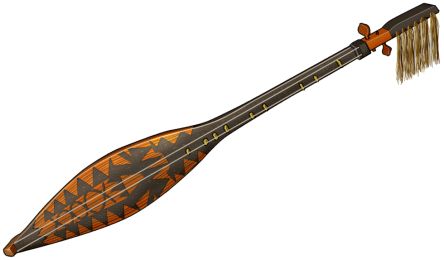
The hegelung is a two-stringed boat-lute with a philosophy of the universe built into its design. It represents change and permanence in its two strings. Continuity and movement. The past and the future playing the same chord at the same time.
But you cannot play the hegelung if nobody teaches you.
You cannot dance the Indak-Indak if nobody passes down the steps.
You cannot weave a T’nalak if nobody sits with you through the hours it takes to learn the patterns.
Traditional knowledge is not archived.
It is transmitted, person to person, generation to generation, and when a single link in that chain breaks the whole thing can go quietly away. An irreversible event no one wants to happen.
When people talk about preserving traditional culture they sometimes make it sound abstract.
Save the culture.
Protect the heritage.
But what does it actually mean when a tradition disappears?
What Goes Quiet When a Tradition Ends?
- A tonal scale that existed nowhere else in the world, built into a specific instrument’s frets
- A dance vocabulary that encoded stories, history, and social meaning in specific movements
- A set of songs that marked the seasons — harvest, planting, grief, celebration — giving community life a rhythm it no longer has
- A way of understanding the relationship between people and land that was expressed through performance rather than text
- An identity marker that told a community who they were and where they came from, every time the music played
- A living language between the generations — the elder who knew the old form, and the child who needed to see it to understand something true about themselves
These are not small things.
And the Philippines, with its hundreds of distinct indigenous groups across 7,000-plus islands, has more of them at risk than most countries in the world.
What Other Places Can Learn from Kadayawan
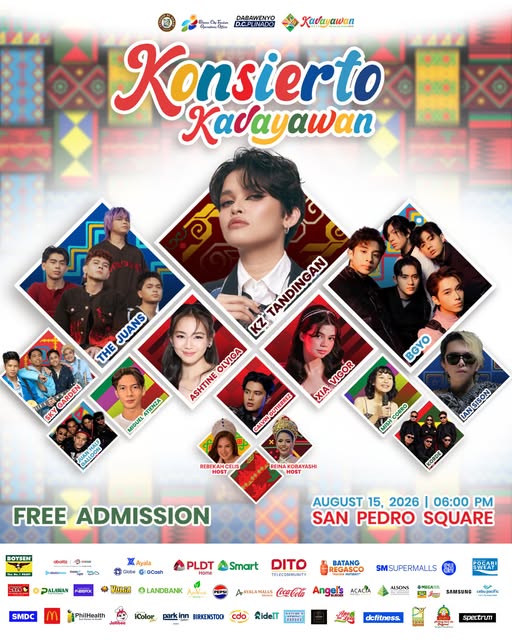
I’ve written about Kadayawan at length because I live in Davao and it’s the festival that shapes August here every year.
It’s just so vastly different from celebrations I’ve witnessed all over the Philippines.
It’s quite unique.
Kadayawan is not a museum exhibit.
It doesn’t put traditional culture behind glass and ask people to look at it respectfully from a distance.
The 11 indigenous and Moro tribes of Davao participate actively — their own members performing their own ancestral dances, wearing their own traditional attire, playing their own instruments, demonstrating their own crafts and cuisine and architecture in the Kadayawan Village in People’s Park.
The Indak-Indak street dancing competition keeps the movement vocabulary alive because it asks the current generation to learn it, embody it, and perform it in public.
The Pamulak floral float parade keeps the agricultural knowledge and craft traditions alive because someone has to actually build those floats from fresh flowers and natural materials.
The Panagtagbo river gathering keeps the history of inter-tribal relationships alive because it reenacts it rather than just describing it.
Every August, Kadayawan creates conditions where the old knowledge has to be transmitted again.
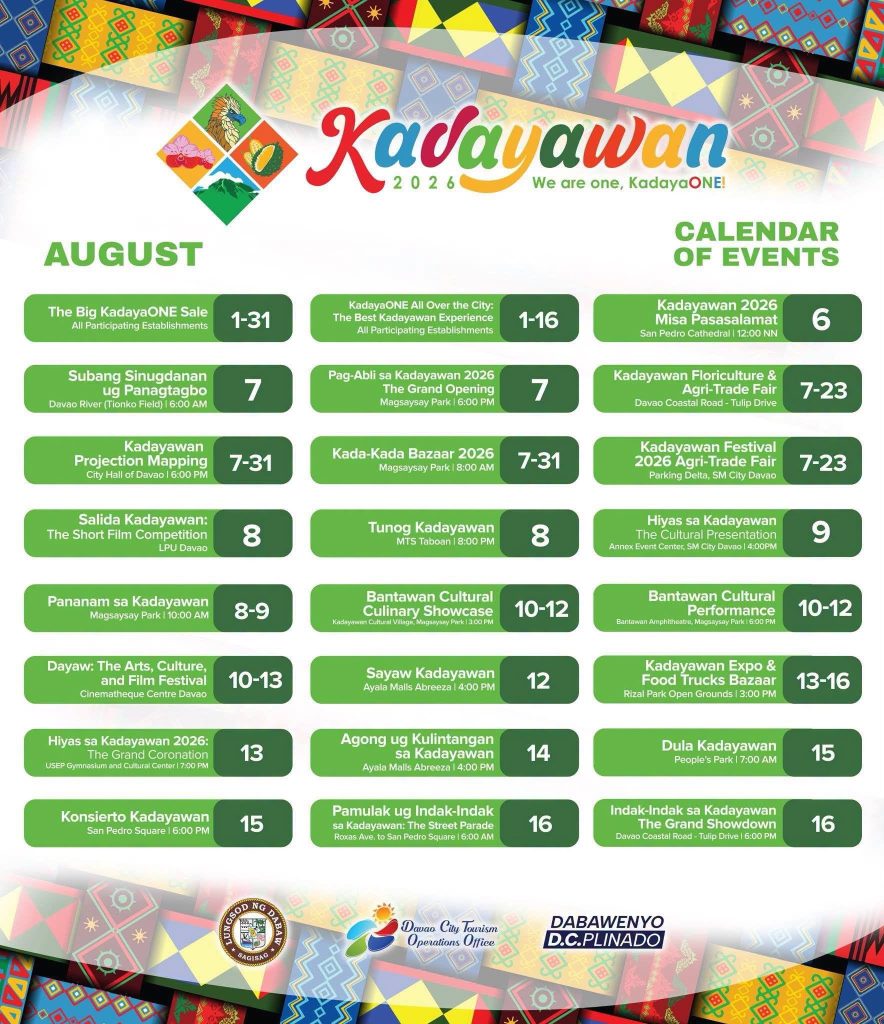
Not because the elders are performing for tourists but because the next generation needs to know it in order to participate.
That’s the structural insight worth copying.
Other regions should be doing the same thing with their own traditions.
And some are.
But not enough, and not consistently enough, and not always with the long-term intentionality that Kadayawan has built over decades.
My kid is growing up in Davao. Which means he’s growing up in a city that has Kadayawan every August.
He’s going to see the floral floats.
He’s going to hear the drums of Indak-Indak.
He’s going to walk through the Kadayawan Village and see the traditional houses of eleven different peoples whose ancestors lived on this island before the first Spanish ship appeared on the horizon.
These tells him that the place he calls home is layered and old and full of meaning that goes far deeper than what he learned this week at school.
That there are ways of understanding music and dance and community and the relationship between people and land that have been refined over generations, that carry wisdom earned through centuries of living in this specific place.
Every Filipino child deserves that. Not just the ones in Davao.
The ones in Tuguegarao and Iloilo and Zamboanga and Cotabato and Batanes.
The ones whose own regional traditions are fading because nobody made the sustained effort to keep them visible.
They deserve to look back someday and see the beauty of what their people made before them. That only happens if the generation alive right now decides it’s worth the effort to transmit it.
I’m a music blogger.
I write about guitars and OPM and gig reviews and gear.
But music isn’t just Spotify playlists and pedalboards.
It’s also a hegelung player in Lake Sebu tapping the floor with bare feet while his fingers move fast enough to make two strings sound like six.
It’s a T’boli woman in traditional ulew headdress playing a rhythm that her grandmother taught her.
It’s Indak-Indak on a Davao street in August with the drums so loud you feel them in your chest before you hear them with your ears.
All of that is music.
And all of it deserves a site like this talking about it.
Keep the old songs.
Teach the dances.
Learn the instruments.
Show up to the festivals — not just for the food and the photos but for what they’re actually doing, which is keeping a chain of knowledge alive that would take centuries to rebuild if it broke.
Kadayawan does this every August in Davao.
The rest of the Philippines can do it too.
The traditions are there.
They just need people willing to carry them forward.
Madayaw.
Valuable.
Beautiful.
Worth keeping.