As an Amazon Associate, I earn from qualifying purchases. That means I earn commissions from my sponsored links or I make money when readers (you) purchase items through my links. Your purchase allows me to continue working as a stay-at-home dad who moonlights as a farmer and a musician. Needless to say, this post contains affiliate links.
I might be wrong but I believe that the 4/4 time signature is the most important time signature in music.
As I’m writing this, the streets are quiet. It’s Black Saturday and there’s a strange stillness in the air… anyway. Moving on.
I was thinking, add a few more musical lessons here to increase the number of interesting things to put here… I might need to ask for additional writers in the future though if I hope to keep this pace up.
Okay so. Four four. If you’ve ever tapped your foot to a song… any song, really… you’ve probably already felt it. Without even knowing what it’s called.
The 4/4 time signature is the most widely used in modern music genres, spanning pop, rock, country, blues, and even jazz. It’s so prevalent that it’s often referred to as “common time,” represented by the symbol “C.”
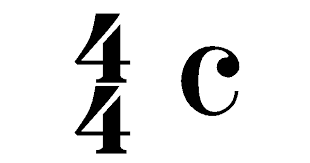
In the 4/4 time signature, the numbers tell you that each measure will contain four quarter note beats.
So each time you tap the beat, you’re tapping the equivalent of one quarter note.
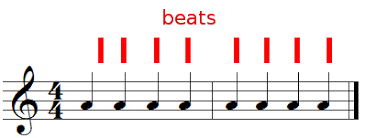
The top number? That’s how many beats per measure.
The bottom number? That tells you what kind of note gets the beat.
Four on the top, four on the bottom.
Simple.
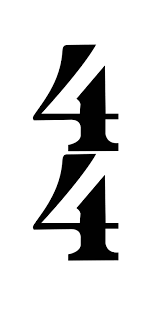
You may also see the 4/4 time written as a “C,” which is called common time. The symbol is actually derived from a broken circle used in music notation between the 14th and 16th centuries.
It doesn’t stand for the word “common” though. That’s just a coincidence that stuck.
A Little History (Bear With Me)
The origin of the 4/4 time signature dates back to early Western music. It emerged during the Renaissance period, around the 15th century.
This era saw composers experimenting with rhythm and meter, leading to more structured compositions. The adoption of four beats per measure allowed for greater musical expression and complexity.
Then came the Baroque period… Bach was writing extensively in 4/4… and by the time jazz, blues, and rock and roll rolled around in the 20th century, it had basically become the default.
The 4/4 became known as “complete-time” throughout different translations due to its resolution by the end of the bar.
Once the first strains of pop music started to crop up in the 20th century, early pop records also featured 4/4 time.
And it never really left.
Holy musical notes batman!

I actually remembered lessons from Yamaha School of Music!
Note to self: enroll Lyle in music lessons.
Why Does It Feel So Natural?
Your heartbeat and bipedal walking rhythm naturally synchronize with 4/4 beats, making this time signature inherently satisfying.
So when you hear a song in 4/4 and your foot just starts moving on its own… that’s your body responding to something it already knows.
In 4/4 time, the first beat of each measure typically carries a strong accent, with a secondary accent often on the third beat.
This creates a consistent, driving rhythm that further contributes to the time signature’s wide appeal.
The strong-weak-medium-weak pattern of accentuation in 4/4 time helps define the rhythmic character of a piece, often highlighting important moments in the melody or harmony.
ONE. two. THREE. four. ONE. two. THREE. four.
That’s it.
That’s the heartbeat.
Famous Songs in 4/4 (Yes, All of Them)
You might be surprised how many of your favorites live in this one time signature:
| Song | Artist | Genre |
| Billie Jean | Michael Jackson | Pop |
| Stayin’ Alive | Bee Gees | Disco |
| Shape of You | Ed Sheeran | Pop |
| Ode to Joy | Beethoven | Classical |
| Overture to the Marriage of Figaro | Mozart | Classical |
| When the Levee Breaks | Led Zeppelin | Rock |
The consistent presence of 4/4 across eras illustrates why it’s so integral to modern music today.
I mean… Beethoven to Zeppelin to Ed Sheeran.
Come on, right?
How to Make 4/4 Feel Fresh Again
Because 4/4 is so common… it can sometimes feel a little… predictable?
Boring even?
But it doesn’t have to be.
Not at all.
While the 4/4 time signature may be common, venturing into other time signatures can provide fresh rhythmic perspectives and open up new musical possibilities.
But you don’t even have to leave 4/4 to make things interesting. Here’s what actually works:
Syncopation. Instead of always hitting the strong beats (1 and 3), accent the weak ones (2 and 4). That’s literally what funk and reggae do. That off-beat feeling is everything.
Change the tempo dramatically. The same 4/4 groove at 60 BPM feels completely different at 140 BPM. Slow it down and it feels heavy, almost cinematic. Speed it up and suddenly it’s a whole different song.
Layer unexpected rhythms on top. Your bassline stays in 4/4 but your melody goes in triplets… or dotted notes… or rests in weird places. The grid stays the same, but what’s on it changes completely.
Try different subdivisions. A 4/4 music will contain 4 beats in each measure, and these beats could contain half, quarter, eighth notes or rests, just so long as the note and rest values combine to the value of the top number of the time signature.
So play with those subdivisions. Eight notes where you expected quarters. Sixteenth note runs. Sudden silence. That’s where the magic is.
Borrow from other genres. A 4/4 groove with a bossa nova feel is completely different from a 4/4 rock groove. Same signature, totally different vibe. It’s all about what you put inside it.
Weird trivia: I’ll have to check where I got this info though because it’s been so long but Tommy Lee of Motley Crue once claimed that all songs are in 4 4 and he proceeded to demonstrate it but it was such a weird way that he did it that it kinda stuck in my head.
4/4 Compared to Other Time Signatures
| Time Signature | Beats Per Measure | Common Use |
| 4/4 | 4 beats | Pop, rock, blues, jazz, country |
| 3/4 | 3 beats | Waltz, folk, some classical |
| 2/4 | 2 beats | Marching music |
| 6/8 | 6 beats (felt in 2) | Ballads, some rock, folk |
| 5/4 | 5 beats | Jazz, prog rock, experimental |
In comparison to the 4/4 time meter, the 3/4 time signature indicates three beats for each measure. It’s the most commonly used signature after 4/4 and is generally considered ideal for waltz music. Its popularity soared around the 19th century, thanks in part to Johann Strauss II.
But notice how all the “unusual” time signatures are defined in relation to 4/4. That tells you everything you need to know about how central it is.
Pros and Cons of 4/4
Look, even the most dominant time signature has its limits:
The Good Stuff
- Easiest to learn and feel naturally
- Works across virtually every genre
- Familiar to listeners everywhere, which means easier connection
- Very flexible… you can do so much within it
- The default for most instruments, especially guitar and drums
- Great for dancing (OPM, EDM, ballads, all of it lives here)
The Tricky Parts
- Can feel predictable or generic if you’re not intentional
- Beginner musicians sometimes get “stuck” in it and never explore other meters
- Overuse in pop music has made some arrangements sound formulaic
- If you want to express odd, asymmetrical emotions… 4/4 might actually fight you
If you’re just starting out with music, or you’re teaching someone… start here.
Start with 4/4.
Get cofortable with it
Feel where beat 1 is. Feel where beat 3 is.
Everything else in music builds on top of that foundation.
And if you’re already experienced?
Go back to 4/4 but challenge yourself.
Put something unexpected inside the grid.
Syncopate.
Breathe.
Silence is a note too.
This is where music starts for most of us.
It’s where it started for me.
And it’s still where I keep coming back.
Help Me Make Some Money for This Site
I earn through the sale coming from these affiliate links.
It won’t cost you extra to buy through them, and I get a small commission which helps me keep this site going. So, if you’re planning on buying one of these items, please consider buying through me. Thank you!
Metronome (for practicing your 4/4 groove)
Music Theory Books for Beginners
Donner Hush I Travel Guitar for Learning Time Signatures
Donner Hush I Travel Guitar for Learning Time Signatures
Thank you! Every little bit helps keep this going.