

As an Amazon Associate, I earn from qualifying purchases. That means I earn commissions from my sponsored links or I make money when readers (you) purchase items through my links. Your purchase allows me to continue working as a stay-at-home dad who moonlights as a farmer and a musician. Needless to say, this post contains affiliate links.
I never learned piano formally.
What little I know I picked up sideways, accidentally, the way most things in music actually get learned.
When I was younger my sister had piano lessons.
I wasn’t enrolled.
But I would hang out at the piano teacher’s house and watch them play, absorbing things without really meaning to, and then go out to play in the yard.
Subconscious retention, I guess.
Like how I first learned how to play guitar.
The notes and lessons were going in even when I wasn’t paying attention.
My sister also had a portable electric keyboard at home.
A small one.
And when she wasn’t using it I’d mess around on it… no structure, no lesson plan, just curiosity.
That keyboard was honestly where my interest in music started before guitar ever happened.
Later on, when I eventually enrolled in Yamaha School of Music for guitar lessons, my teacher briefly walked me through where chords were on the piano and how to form them before we focused on the guitar.
That was it.
That was my entire formal piano education.
A few minutes of chord shapes on a keyboard as a warm-up to learning guitar.
I’m nowhere near beginner level as a pianist.
I guess I just have to say that.
But I know where to find things on the keys, and before I learn anything I tend to geek out and build a lesson plan for it first… so here’s what I would’ve told myself when I first sat down at a keyboard and had absolutely no idea what I was looking at.
· · ·
First. Find the Middle C.
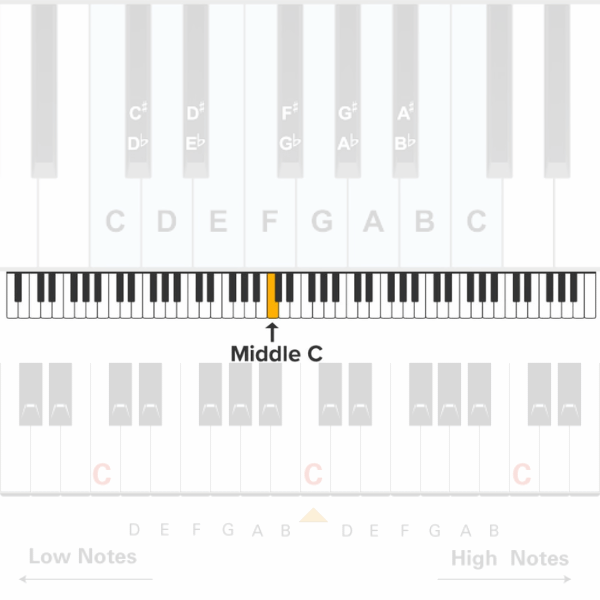
The whole keyboard makes sense once you find this one note.
Everything else is just this same pattern repeating to the left and to the right.
Look at the black keys.
They appear in groups of two and groups of three, alternating all the way across the keyboard.
Find a group of two black keys.
The white key directly to the left of those two black keys is C.
Now find the C that’s roughly in the middle of the whole keyboard.
That’s Middle C.
That’s your home base.
That’s where everything starts.
One Octave · Middle C to C
The white keys spell out seven notes: C D E F G A B. And then it starts over at C again. That repeating group is called an octave and the whole keyboard is just that same seven-note pattern going left (lower, deeper) and right (higher, brighter) over and over.
Once you see it, you can’t unsee it.
The seven white notes in order, starting from Middle C:
CDEFGABC
The black keys are the sharps and flats in between… C#, D#, F#, G#, A#. You don’t need to worry about those yet. Just the white ones for now.
The Five-Finger Position
Once you find Middle C, put your right thumb on it. Then let each finger fall naturally on the next white key. Don’t stretch. Don’t force it. Just let them land where they land.
1ThumbC
2IndexD
3MiddleE
4RingF
5PinkyG
Five fingers. Five notes. C D E F G. That’s your starting hand position and from just those five notes you can already pick out simple melodies. Go up. Go down. Try to make something that sounds like a tune. Your ear will guide you more than you expect.
Play Something Familiar
Before anything else, just try playing Bahay Kubo. Most of us grew up with this song and your ear already knows how it should sound, which means you’ll know immediately if you’re hitting the right notes or not.
Just the opening line to start. Slow it way down. Don’t worry about timing yet. Just find the notes and let your ear confirm them. When it sounds right, it is right.
That right there. That’s a melody played entirely within the five-finger position starting on Middle C. You just played piano. It wasn’t fancy but you played it.
Now the Basic Chords
If you came here from the guitar lessons, this part will feel familiar. A chord is just multiple notes played at the same time.
On piano the three most useful starting chords are C major, F major, and G major and they all sit right there in your first-position hand placement.
C major: fingers 1, 3, and 5 together. That’s C, E, and G pressed at the same time.
Try it.
That big, open, resolved sound… that’s a major chord.
That’s happy.
That’s the sound of a song landing somewhere safe.
A minor: same hand position, fingers 1, 3, and 5 again but now you’re on A, C, and E.
Slide your hand slightly to the right so your thumb lands on A.
Press those three.
Hear how it feels different from C major?
Softer.
More melancholic?
That’s a minor chord doing its thing.
This shouldbe enough for your first session.
Find the Middle C.
Learn the seven white notes.
Put your five fingers down.
Play Bahay Kubo.
Play a C chord.
Sit with that for a day or two and let it settle in before adding anything new.
I wish I’d taken piano more seriously when I had the chance to learn properly. Watching my sister’s lessons through the window and then sneaking onto her keyboard later… that was a start but it wasn’t a plan.
If you have a keyboard gathering dust at home right now, pull it out.
You don’t need a teacher for this part. You just need the Middle C and a little patience with yourself.