
As an Amazon Associate, I earn from qualifying purchases. That means I earn commissions from my sponsored links or I make money when readers (you) purchase items through my links. Your purchase allows me to continue working as a stay-at-home dad who moonlights as a farmer and a musician. Needless to say, this post contains affiliate links.
A community in grief has the right to grieve together.
For musicians, playing music together has always been how we do that.
Tonight we’re holding a tribute gig for our friend Givanne.
Some of the best musicians in Davao are coming.
His friends.
We’re coming together to grieve the way musicians grieve — through music.
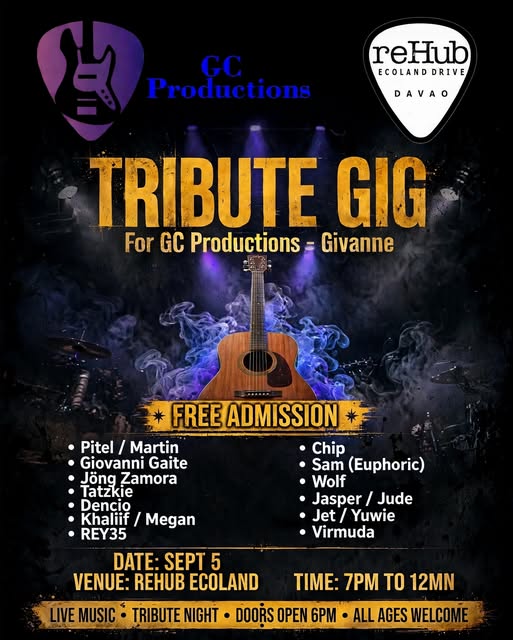
This will be an unplugged/acoustic tribute gig featuring artists who have previously worked with or been organized by GC Productions.
Let us come together to celebrate his life through music and memories, remembering his dedication and kindness in nurturing the local music scene.
This should be a pretty straightforward thing.
The Davao music scene has always been a community fist and foremost of like minded people who eventually became really good friends.
We don’t necessarily come from the same walks of life but somehow, through music, we found each other.
And this community just lost someone they love. Coming together to honor his memory, to play the music he likes, to sit in the same room and feel the weight of the loss together instead of alone.
It’s a tribute gig to his impact in the local scene.
This tribute is not for profit.
No one is selling tickets.
No one is making money from it.
The entire purpose is to gather, to play, to remember, and to grieve together as a community that loved him.
If any money is collected — if a hat is passed around, or a voluntary contribution from people who want to give something is given — then it is just right that every peso collected goes to his family.
That is what his friends do.
Because it’s the right thing to do.
A recent troubling issue we face is there’s an informal cease and desist order given by his widow. Now for what reason she may have for issuing it I don’t really know.
And I am torn between the grief I feel for losing a friend and respecting the grief felt by his actual family.
We could have just made this into a private affair where no one else was invited except the inner circle that knew him best but the reason why it was made public in the first place was because there might still be others out there who have not been given the chance to grieve.
Legally, there’s no way anyone can stop a tribute gig from happening unless we try to profit from it.
Again, this is a non-commercial tribute gig — one held just to grieve a friend, and not to generate profit.
It’s not illegal to do it anywhere else in the world and neither is it illegal to do in the Philippines.
Playing music in memory of someone, gathering to celebrate their life and mourn their absence, is something communities have done for as long as there have been communities.
No one has, or should have, the legal authority to stop that simply by objecting to it.
We understand she is also grieving.
We understand that grief can feel like everything is out of control and that an event she didn’t organize, held in the name of someone she loved, might feel threatening or strange or wrong in ways that are hard to articulate.
Grief does that.
It makes things feel like attacks that aren’t attacks at all.
But her pain, which is real and valid, does not override the pain of everyone else who lost him too.
His friends lost him too.
The Davao music community lost him too.
And we have the right to honor that loss.
Why Does a Tribute Gig Matter?
Music Is How We Grieve
Tribute gigs are not a new invention.
They are probably almost as old as music itself.
When a musician dies — when any member of a musical community dies — the people left behind gather and play.
It doesn’t fix anything or bring him back to life, in a literal way….
But this is the only language that comes naturally close to holding what needs to be said.
You cannot fully express grief in a Facebook post.
You cannot process the loss of a friend in a private room alone if that friend was someone whose life was lived publicly through music.
I want to say this as clearly as I can: we are not doing this to disrespect anyone.
We are not doing this to profit from his death.
We are not doing this to make a statement or start a conflict.
We are doing this because he mattered to us and music is how we know how to say that.
If she reads this, I hope she understands that every person who shows up tonight loved him. And I hope that means something to her. Perhaps not today, perhaps not tomorrow but someday
Get the Gear
These are affiliate links to some of the products listed in this article. It costs you nothing extra to click on these links and buy the products and on the plus side, it helps keep this site going.