

As an Amazon Associate, I earn from qualifying purchases. That means I earn commissions from my sponsored links or I make money when readers (you) purchase items through my links. Your purchase allows me to continue working as a stay-at-home dad who moonlights as a farmer and a musician. Needless to say, this post contains affiliate links.
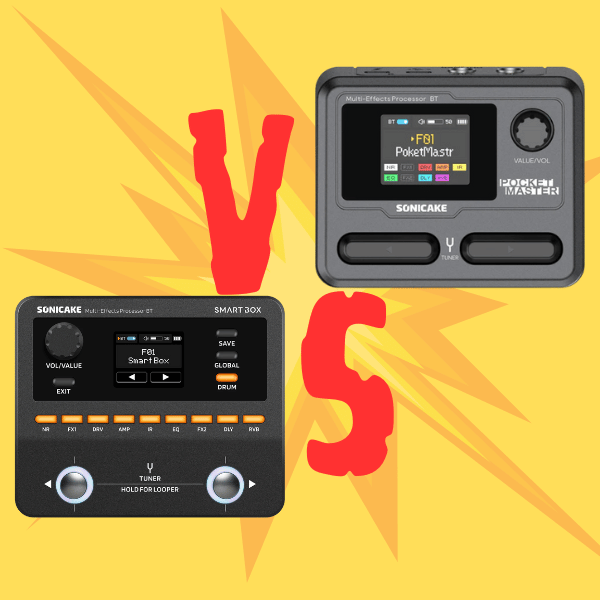
So you’re looking at Sonicake’s multi-effects lineup and wondering whether to grab the budget-friendly Pocket Master (QME-10) or invest a bit more in the newer Smart Box (QME-20).
I’ve spent time with the specs on both units, and honestly, the decision isn’t as straightforward as “get the more expensive one.”
Each pedal serves different needs, and the right choice depends entirely on how you plan to use it.
Is it Worth the Php1,500 Price Increase?
The Pocket Master sits at Php 3,500.00, while the Smart Box will set you back Php 5,000.00. That’s a Php 1,500.00 difference—not pocket change for budget-conscious players, but also not a deal-breaker if the extra features actually matter to your playing situation.
The question isn’t whether the Smart Box is better (it objectively is), but whether those improvements justify the price jump for your specific needs.
Sem Sem But Deperent
Both units share Sonicake’s white-box digital modeling technology with 24-bit/44.1kHz signal processing and an impressive 103dB signal-to-noise ratio. They both support third-party impulse response (IR) files with 5 user slots, making them surprisingly flexible for tone customization at this price point.
Where they diverge is in implementation and expandability. The Smart Box adds Neural Amp Modeler (NAM) support alongside IR files, opening up a massive library of professional amp captures that simply weren’t possible on the Pocket Master. If you’re the type who spends hours on ToneHunt.org downloading amp profiles, this alone might seal the deal.
Both units run 9 simultaneous effect blocks with editable signal chains, but the Smart Box expands the overall effect count from 100+ to 130+, giving you more sonic options to work with.
Portability vs. Performance
Here’s where your decision gets interesting.
Pocket Master: 103.5mm × 85mm × 28.5mm, weighing just 194g. This thing is genuinely pocket-sized and feels more like a larger smartphone than a guitar processor. The single 1/4″ stereo/headphone output keeps things simple but limits your connectivity options.
Smart Box: 135mm × 114mm × 51mm, weighing 378g. Nearly twice the weight and significantly larger, but still compact enough to toss in a gig bag. The trade-off? You get true stereo 1/4″ outputs PLUS an independent headphone output, metal footswitches with multi-color LED rings, and an EXP/FS input for expression pedals or external footswitch expansion.
If ultimate portability for headphone practice is your priority, the Pocket Master wins. If you need stage-ready features and expandability, the Smart Box justifies its larger footprint.
More Smart Box Advantage
This is where the Smart Box pulls significantly ahead.
The Pocket Master relies heavily on its mobile app and desktop software for serious sound editing. While it has a color LCD screen, on-device control is limited. You’ll be reaching for your phone or laptop for most tweaking sessions. For bedroom players who always have their devices nearby, this is manageable. For live situations or quick sound checks, it’s frustrating.
The Smart Box adds 9 dedicated module-select buttons that let you jump directly to specific effect blocks without menu diving. Combined with the HD color LCD, you can make meaningful adjustments right on the unit. The metal footswitches (which the Pocket Master completely lacks) enable tap tempo and instant effect toggling with visual LED feedback—a massive upgrade for anyone playing live.
Connectivity
Both units function as USB audio interfaces with stereo streaming and OTG support for iOS and Android devices. Both have built-in lithium batteries claiming up to 4 hours of use (though the Smart Box doubles the battery capacity from 1000mAh to 2000mAh for more consistent performance).
The Smart Box adds several critical features:
- True stereo outputs instead of a single headphone jack—run stereo effects into two amps or feed the PA while monitoring through headphones
- Wired and wireless BT-MIDI—control the unit via external MIDI controllers
- USB loopback and re-amp support—essential for modern recording workflows
- EXP/FS input—connect expression pedals for real-time wah, volume, or parameter control
- USB-C charging—more convenient than the Pocket Master’s USB-C-only power
The Pocket Master added USB MIDI support in firmware v1.3.3, but it’s limited to wired USB connectivity, not the wireless BT-MIDI that the Smart Box offers.
Shared Features
Both units include features that punch well above their price points:
- 100 preset slots (50 factory, 50 user)
- Built-in drum rhythms (99 on Pocket Master, 100 on Smart Box)
- 20-second looper
- Built-in chromatic tuner
- Intuitive mobile apps and desktop editors (SONICLINK and Sonicake Manager)
- Optimized presets for guitar, bass, and acoustic simulation
Which One is Best for Live Performance?
For gigging musicians, the Smart Box is the obvious choice. The metal footswitches alone transform it from a practice tool into a legitimate stage unit. Add in the independent headphone output for monitoring, true stereo outs for running to FOH, expression pedal support for hands-free control, and wireless MIDI connectivity, and you’ve got a genuinely professional setup.
The Pocket Master simply wasn’t designed for this use case. Without footswitches, you’re limited to preset changes via the unit’s controls or app—fine for recording, impractical for live switching mid-song.
Bedroom Players and Home Recording
If you’re primarily practicing with headphones, recording ideas on your phone, or doing basic home recording, the Pocket Master delivers 90% of what you need for less than Php 3,500.00.
The ultra-compact size means you can practice literally anywhere—on the couch, in bed, at a coffee shop. The single headphone output is actually simpler if you’re not running stereo rigs.
The Smart Box offers genuine advantages for home recordists, though. The USB loopback function lets you monitor backing tracks while recording. The re-amp support means you can record dry signals and process them later with different presets or NAM profiles. If you’re building a compact home studio, these features matter.
For pure headphone practice and casual songwriting? The Pocket Master is plenty. For home recording where you want maximum flexibility? The Smart Box earns its keep.
Feature Comparison Table
| Feature | Pocket Master (QME-10) | Smart Box (QME-20) |
| Price | $64.99 | $94.99 |
| Modeling | White-box digital + IR support | White-box digital + NAM + IR support |
| Effects | 100+ | 130+ |
| Amp Models | 20 legendary types | Expanded amp library |
| Presets | 100 (50 factory, 50 user) | 100 (50 factory, 50 user) |
| Drum Rhythms | 99 | 100 |
| Looper | 20 seconds | 20 seconds |
| Signal Processing | 24-bit / 44.1kHz, 103dB SNR | 24-bit / 44.1kHz, 103dB SNR |
| Simultaneous Effects | 9 blocks | 9 blocks |
| On-Device Controls | Limited, mostly app-dependent | 9 dedicated module-select buttons |
| Display | Color LCD | HD color LCD |
| Footswitches | None | 2 metal with LED rings |
| Outputs | Single 1/4″ stereo/headphone (100Ω) | True stereo 1/4″ (1kΩ) + independent 1/8″ phones (22Ω) |
| EXP/FS Input | No | Yes (1/4″ TRS) |
| MIDI Support | USB MIDI (wired, v1.3.3+) | Wired + wireless BT-MIDI |
| USB Features | Audio interface, stereo streaming, OTG | Audio interface, loopback, re-amp, OTG |
| Battery | 1000mAh (~4 hours) | 2000mAh (~4 hours) |
| Dimensions | 103.5 × 85 × 28.5mm | 135 × 114 × 51mm |
| Weight | 194g | 378g |
| Power Options | USB Type-C, DC 5V | DC 9V center negative (>700mA), USB Type-C DC 5V (>1A) |
The Pros and Cons
Pocket Master (QME-10)
Pros:
- Incredibly affordable at Php 3,500.00
- Ultra-compact and truly pocket-sized (194g)
- Same core white-box modeling and signal processing quality
- 100+ effects with 20 amp models more than adequate for most players
- USB audio interface with OTG support
- 4-hour battery life for extended practice sessions
- Perfect for headphone practice anywhere
- Available in 8 color options (though some sold out)
Cons:
- Limited on-device control—heavily app-dependent for editing
- No footswitches for live performance
- Single output limits connectivity options
- No expression pedal support
- No NAM support (IR only)
- Smaller battery capacity (1000mAh)
- No wireless MIDI (wired USB MIDI only as of v1.3.3)
- 100Ω headphone output impedance may not be ideal for all headphones
Smart Box (QME-20)
Pros:
- NAM support opens up professional amp modeling possibilities
- 130+ effects with expanded sonic palette
- 9 dedicated module-select buttons for intuitive on-device control
- Metal footswitches with LED rings for live performance
- True stereo outputs plus independent headphone jack
- Expression pedal and footswitch expansion via TRS input
- Wired and wireless BT-MIDI for advanced control
- USB loopback and re-amp support for recording
- Double the battery capacity (2000mAh)
- Stage-ready feature set
- Lower headphone output impedance (22Ω) for better compatibility
Cons:
- Php 1,500.00 more expensive (Php 5,000.00 vs Php 3,500.00)
- Significantly larger and heavier (378g vs 194g)
- More complex—may be overkill for simple practice needs
- Requires 9V DC or 1A USB-C for optimal performance
- Power supply not included
- Newer product with less long-term user feedback
- Steeper learning curve for all the features
The Importance to Guitarists
Both the Pocket Master and Smart Box represent something important in the guitar effects world: genuine quality at genuinely affordable prices.
For years, budget multi-effects meant compromised tone, frustrating interfaces, or limited features. You either spent hundreds on flagship units from Line 6, Boss, or Headrush, or you settled for toys. Sonicake changed that calculation.
For Bedroom Players: These units eliminate the need for multiple pedals, dedicated amps, or expensive recording interfaces. You can plug in, throw on headphones, and access professional-quality tones immediately. The built-in drum rhythms and loopers turn practice sessions into complete songwriting environments. For casual players or those just starting out, this is transformative.
For Live Performers: While the Pocket Master remains primarily a practice tool, the Smart Box offers legitimate stage capability. You can build a complete rig around the Smart Box, control it with expression pedals or MIDI controllers, and trust it to deliver consistent performance night after night. At Php 5,000.00, it’s a credible backup rig or even a primary solution for smaller venues—something that simply didn’t exist at this price point before.
For Home Recordists: The USB audio interface functionality and OTG support mean you can capture ideas instantly on your phone or record directly into your DAW with zero additional hardware. The Smart Box’s re-amp support takes this further, letting you experiment with different tones after tracking. This workflow flexibility used to require hundreds of dollars in separate interfaces and software.
My Recommendation
Here’s how I’d break down the decision:
Get the Pocket Master (Php 3,500.00) if:
- You’re primarily practicing with headphones
- Ultimate portability is your priority
- You’re on a tight budget
- You’re a beginner or casual player
- You always have your phone/tablet nearby for editing
- You don’t plan to gig with it
- The color options appeal to you
Get the Smart Box (Php 5,000.00) if:
- You perform live or plan to
- You want professional NAM amp modeling
- You need expression pedal control
- You record at home and want re-amp capability
- On-device control matters more than pocket-size
- You want room to grow into advanced features
- The extra Php 1,500.00 won’t strain your budget
If you can afford the extra Php 1,500.00 and have any interest in live performance or advanced recording, get the Smart Box.
You’ll grow into the features and appreciate the expandability. But if budget is genuinely tight or you know you’ll only use it for headphone practice, the Pocket Master delivers remarkable value and won’t leave you wanting for basic functionality.
Both units represent Sonicake’s commitment to making quality tone accessible. Neither is a compromise—they’re just optimized for different use cases. Choose based on your actual needs, not just spec sheet bragging rights.
Oh and if you want any one of the multi-effects pedals mentioned in the article, you can get it here:
Buy the Sonicake Pocket Master on Shopee
Buy the Sonicake Pocket Master on Amazon
Buy the Sonicake Smart Box on Shopee
Buy the JOYO Jam Buddy II on Shopee
It won’t cost you extra to buy it and I get a nice little commission which helps me keep this website going.
Thank you!