
Religion vs Metal: A Never-Ending Issue
As an Amazon Associate, I earn from qualifying purchases. That means I earn commissions from my sponsored links or I make money when readers (you) purchase items through my links. Your purchase allows me to continue working as a stay-at-home dad who moonlights as a farmer and a musician. Needless to say, this post contains affiliate links.
This isn’t an attack on faith — it’s a reflection on how sound and spirit collide, and why both sides deserve to be understood.
Inspired by a recent debate about faith and heavy music, this piece dives into where belief ends and expression begins.
Read with an open heart, listen with open ears.
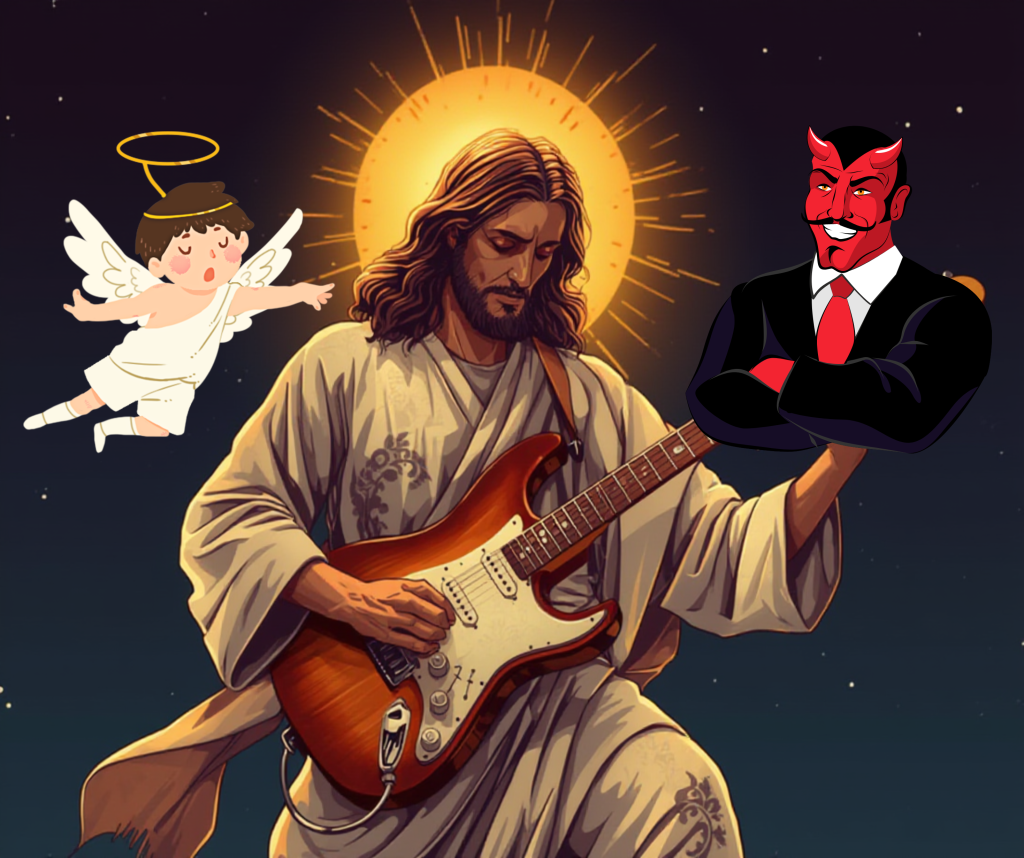
When Faith Calls Out Sound
Recently, a pastor called out a Christian musician online, saying that playing metal is “too much” — that their faith needs to be checked.
And I couldn’t help but ask: is God really that weak and narrow, that something as insignificant as a genre can be blasphemous?
I refuse to believe in a God that fragile.
I refuse to worship a creator who can be shaken by a distortion pedal or a scream in 4/4 timing.
The problem isn’t the music — it’s how people misunderstand expression. Metal just happens to be louder, rawer, and more honest than most are comfortable hearing.
The Roots of the Clash
There’s always been a silent war between religion and metal. It never really stopped — it just changed faces, changed preachers, changed guitars. Every few years, someone new comes along to remind us that heavy music is “the devil’s work,” that screaming means blasphemy, and distortion equals rebellion against God.
But here’s the truth: rebellion doesn’t always mean hate. Sometimes rebellion means searching for what’s real.
Metal was never born out of evil. It was born out of pain — out of a world that didn’t listen, out of systems that preached morality but ignored suffering. While the church was telling people to keep quiet and pray, metal screamed the questions everyone else was too afraid to ask. “Why does pain exist?” “Why do we suffer?” “Where is God in all this noise?”
The Other Side of Darkness
Let’s be real — yes, there are bands that go full-on anti-religion. Black metal, NSBM, and other extreme subgenres dive into the imagery of blasphemy, rebellion, and even hate. Some do it as shock art, some as ideology, some as a mirror to the hypocrisy they see in religion itself.
But here’s the thing: the same world that produces “satanic” songs also produces Christian metal. The same genre that roars “Hail Satan” also sings “Praise the Lord” — and both can exist in the same record store aisle.
You don’t judge an entire forest because of a few dead trees. Art, like faith, exists in a spectrum. Every song — even the hateful ones — reveals something about the human condition. And sometimes, anger is just a reflection of how deep the wound of belief goes.
Faith, Tribe, and the Scene
As a Muslim here in Davao, I’ve seen both sides up close. My tribe, my faith, my history — they’re part of who I am. But when I step into a gig, when the feedback hums and the crowd moves, all those labels dissolve.
Music unites what religion often divides.
Inside a moshpit, no one asks who you pray to.
They just move with you — to the same pulse, the same noise, the same moment.
That’s what makes this scene sacred in its own way. It’s not about rejecting God — it’s about finding connection in chaos. About proving that spirituality can exist beyond walls and rituals.
Defending the Unholy
Even the songs that curse religion — they deserve to exist. Because suppression only breeds ignorance. When we silence anger, it doesn’t disappear; it mutates.
Anti-religious art, as offensive as it may sound to some, is part of the balance. It’s the shadow that reminds faith of its light.
It’s the side that forces believers to reflect: Have we become the very oppressors our own scriptures warned us about?
Extremism — on either side — is what poisons the world, not expression. And rebellion, when honest, can be a sacred act.
Finding Holiness in Noise
If religion is supposed to connect us to something greater, then metal does the same thing in its own language. The pit becomes a kind of church. The stage becomes a pulpit. The riffs are our hymns, the screams our confessions.
Maybe metal and religion aren’t enemies at all — maybe they’re just two sides of the same coin. One kneels, one roars. Both search for meaning in a broken world.
At the end of the day, faith and music share the same wound: both are born from longing. The longing to understand, to be free, to find something divine inside the noise.
So no, metal isn’t the devil’s music. It’s humanity’s music — messy, loud, imperfect, but real.
And if God is truth, then maybe He’s been headbanging with us all along.

Musikahan sa Tagum 2026

Loving My New Popcorn Bass X8 Pro

Create a Professional-Looking Website and Online Presence
About The Author
